Regulatory Compliance: One of the Best Forms of Marine Insurance
In international shipping, the best way to reduce losses is not always broader insurance cover, but strict regulatory compliance. Throughout


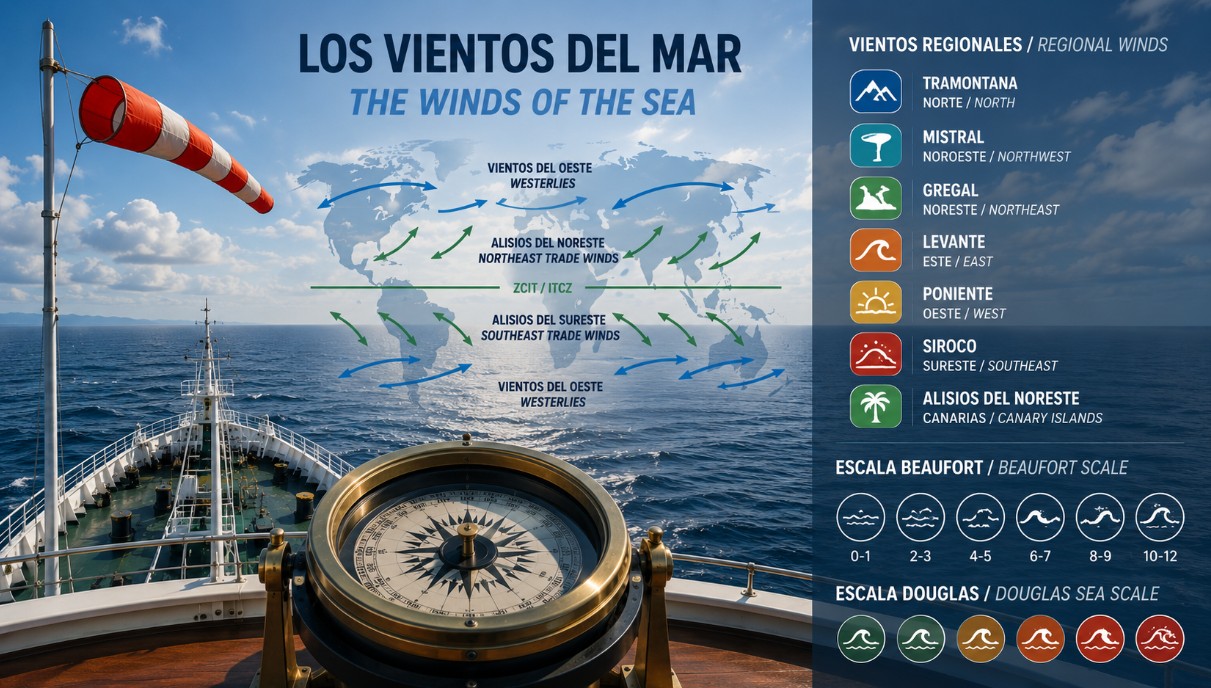
In the maritime industry, understanding a wind’s origin, direction and behaviour is essential for planning a safe passage, optimising manoeuvres and anticipating sea conditions. Wind has a direct impact on navigation, fuel efficiency, vessel stability and crew safety.
There are global prevailing winds, such as the Trade Winds, which have guided ocean navigation for centuries, together with important regional winds that significantly influence coastal operations. In the Mediterranean, mariners frequently encounter the Tramontana, Mistral, Gregale, Levanter, Poniente (Westerly) and Sirocco, while in the Canary Islands the northeasterly Trade Winds shape maritime operations for much of the year.
Beyond identifying a wind by name, maritime professionals assess its strength using the Beaufort Wind Scale, the international standard for describing wind force at sea, together with the Douglas Sea Scale, which classifies the sea state generated by the wind. These are essential tools for safe decision-making on board.
For shipowners, port operators, Masters, marine pilots, ship agents and P&I correspondents, correctly interpreting maritime winds helps reduce operational risks, improve manoeuvring efficiency and enhance navigational safety throughout every voyage.

More information at:
GRUPO STIER
Ship Agency
P&I Correspondents, Surveys.
+ 34 607 55 29 27
+ 34 650 24 75 74
www.stier.es
pandi@stier.es
agency@stier.es
In international shipping, the best way to reduce losses is not always broader insurance cover, but strict regulatory compliance. Throughout
Although Asia remains the undisputed engine of global manufacturing, port traffic, and shipbuilding, it is European shipping companies that control